
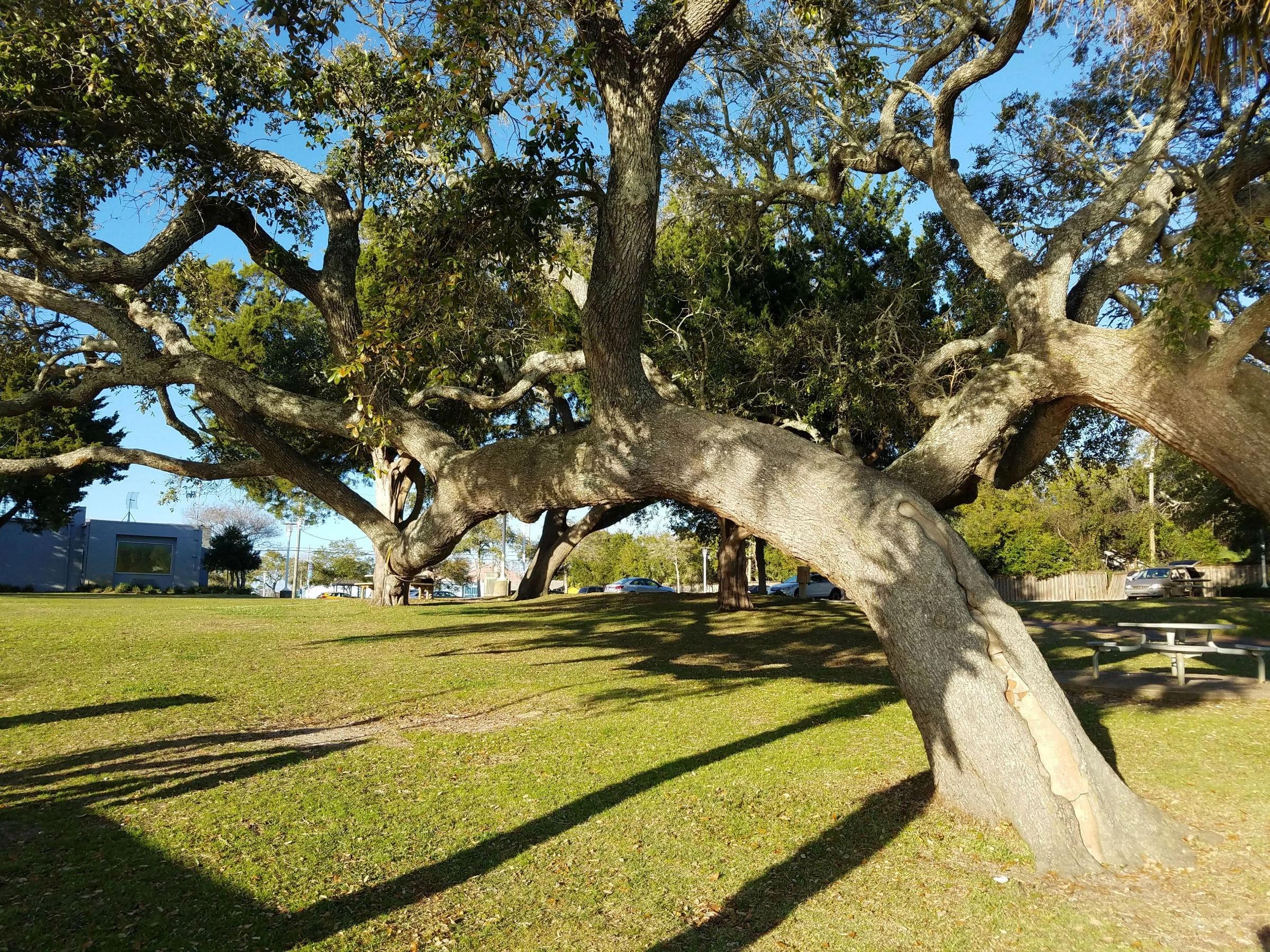
When a tree is leaning, the most important question isn’t how far it leans. It’s whether the lean is new or if it’s been there for years. Most trees lean a little, and a gradual, long-standing lean is usually fine.
A lean that appeared recently, is getting worse, or shows disturbed soil at the base, is the one that signals real danger. That’s when you need to start thinking about how to fix a leaning tree. What you can do about it depends on the tree’s size, the cause of the lean, and how close it stands to a house, power line, or other vulnerable spot.
If your tree has started leaning toward a structure recently, or the lean is getting worse, do not wait. Call our emergency tree services for an immediate assessment.
Is Your Leaning Tree Dangerous? The 60-Second Check
Run through this standing in your yard. The goal is not to measure a perfect angle. It’s to spot the signs that a tree is actively failing.
- Is the lean new or old? This is the most important question. A tree that has leaned the same way for years is usually stable. A lean that appeared or worsened in the last few months is the dangerous kind.
- Check the base for root heave. Look for soil cracking, or a mound of raised soil on the side opposite the lean. That mound means the root plate is lifting out of the ground, which is a serious failure sign.
- Look at the ground around the trunk. Fresh cracks in the soil, especially in a semicircle on the lean side, mean the tree is actively moving right now.
- How steep is the lean? On a mature tree, a lean past roughly 15 degrees from vertical is worth a professional look. But angle matters less than the other signs. A tree at 25 degrees that has stood that way for decades with sound roots is often safer than one at 5 degrees with heaved soil over a bedroom.
- What is below the tree? A lean over an open field is a different problem than a lean toward your house, driveway, power line, or play area.
- Any recent trigger? A storm, saturated ground, or nearby digging in the last year makes any lean more suspect.
If the lean is new or progressing, or you see root heave, treat it as urgent and get an assessment before the next storm or heavy rain.
5 Reasons Your Tree Started Leaning
The cause of a lean determines whether it is dangerous and what can be done about it.
- Root failure. The root plate has partially pulled loose, usually after a storm, saturated soil, or root damage from construction. This is the most dangerous cause, and the tells are soil heave, torn or exposed roots, and cracks in the ground around the base.
- Uneven growth toward light. Trees crowded on one side grow toward available sun. This is a slow, natural lean that is usually not dangerous, though it can become a structural concern in a large mature tree.
- Wind loading. Trees on exposed sites gradually lean away from the prevailing wind. A slow, stable lean in this pattern is usually fine.
- Weight imbalance in the crown. Lopsided branch growth, ice loading, or one-sided pruning creates a heavy side that pulls the trunk over. This is often correctable with weight-reduction pruning.
- A hidden structural defect. Internal decay, an old wound, or included bark at a co-dominant union can let a tree start to lean. You often cannot see the cause directly, but mushrooms at the base or bark abnormalities are the warning signs.
The pattern that matters: root failure and structural defects are dangerous. A slow lean from light or wind usually is not. UC Master Gardener guidance on leaning trees offers a good overview of these causes.
How to Straighten a Leaning Tree (Small Trees Only)
For a young, newly planted tree, correcting a lean is a reasonable do-it-yourself job. For anything mature, it is not, and this is the line that matters most.
Good candidates: newly planted trees and saplings with a trunk under about 4 inches in diameter, a lean under roughly 20 degrees, and no sign of root heave. If the tree has been leaning for years, staking will not fix it, because the wood and roots have already grown to hold that position. Trying to force it upright can do more harm than good.
What you’ll need: two or three stakes, soft strapping or tree straps (never wire or bare rope against the bark), and a shovel.
The steps:
- Straighten the tree gradually over several days, not all at once. Pulling it upright in a single motion snaps the roots you are trying to save.
- Once it is upright, drive two or three stakes into firm, undisturbed soil in a triangle around the tree.
- Attach soft straps loosely enough to allow a little movement, since some sway actually helps the trunk grow strong.
- Leave the tree staked no longer than one growing season, up to a year at most. Staking longer produces a weak, dependent trunk.
What not to do: do not run wire or garden hose against the bark, do not stake for more than a year, do not yank the tree upright in one pull, and do not attempt any of this if you see root heave. Those are signs that you need a professional.
How to Brace a Large Leaning Tree
Learning how to brace a large leaning tree mostly means learning when to hand it off. On a mature tree, this is professional work, not a weekend project, and the wrong approach can accelerate a failure.
An ISA-certified arborist has a few real options:
- Cabling and bracing uses steel cables high in the canopy or threaded rods through a weak union to support the tree, and it works best when the lean comes from weight imbalance or a healed defect rather than active root failure.
- Weight-reduction pruning removes heavy limbs from the leaning side to take the load off the root plate, and it is sometimes the only intervention a tree needs.
- Guy anchoring with wide straps and ground anchors can support a larger young tree during establishment.
What does not work is just as important: homeowner-installed guy wires or winching on a mature tree, and backfilling soil around a root plate that has already heaved. Bracing a tree with active root failure is dangerous, and it often only delays a failure rather than preventing it. Any of these calls should follow a proper assessment. For young-tree support done right, ISA guidance on planting and staking young trees covers the standards.
When Removal Is the Right Answer
Sometimes the safe recommendation is removal, not repair. Take that seriously if you see any of these:
- A lean that is new and progressing, especially with a mature tree.
- Visible root heave or fresh soil cracking around the base.
- The tree stands within falling distance of a house, driveway, or power line.
- Structural defects in the trunk, such as splits, cavities, or mushrooms.
- A species prone to catastrophic failure, like Bradford pear, silver maple, or willow, with any significant lean.
- The cost of proper bracing exceeds what the tree is worth to keep.
For a small tree, taking it down is a straightforward cut. For a large leaning tree near a structure, this is dangerous tree removal, and it is genuinely one of the most hazardous jobs in a residential yard. It calls for professional rigging and often a crane, because the tree’s weight is already loaded in the direction you least want it to go. Knowing how to fell a leaning tree of that size safely is a trained skill, and how to cut a leaning tree under tension without it splitting or kicking back is not something to learn on your own property.
Our tree removal services handle these safely, and for a tree tightly boxed in against a house, crane-assisted tree removal lets us lift the sections straight up and out rather than dropping them past the structure. Do not attempt to fell a large leaning tree yourself.
Common Leaning Trees in Berks County
A few species and situations come up again and again on local properties.
- Silver maple grows fast, has shallow roots, and is prone to root heave after wet years. It is common in older Pennsylvania neighborhoods.
- Bradford pear often starts leaning after a heavy fruit load or an ice storm, and it tends to fail catastrophically once it goes.
- White pine can lose its grip when the soil is saturated, especially in the wetter parts of the service area.
- Storm-affected trees of all kinds develop new leans every year, driven by Pennsylvania’s freeze-thaw cycles and summer thunderstorms.
The clay-heavy soils common across Berks County hold water and make root-plate failure more likely after heavy rain than in sandier regions. Penn State Extension on leaning trees is a solid local resource for understanding the different kinds of lean and when one is cause for concern.
Frequently Asked Questions
Can you straighten a leaning tree?
For a small tree (a trunk under about 4 inches, no root heave, a lean under roughly 20 degrees), yes, using staking and gradual correction over several days. For a mature tree, usually not. The realistic goal becomes stabilization through bracing and pruning, not straightening, and a chronic lean that has held for years cannot be corrected at all.
Will a leaning tree correct itself?
A slightly leaning young tree can straighten over time as it responds to gravity and light. A mature tree will not. It may add wood on the low side to reinforce itself, but the visible lean stays where it is.
Will a leaning tree eventually fall?
It depends on the cause. Trees with slow, stable leans from growth or wind can stand for decades. A tree with a fresh lean from root failure often comes down in the next one to three significant storms. An assessment is the only reliable way to know which situation you have.
Is it safe to sleep in my house if a large tree is leaning toward it?
If the lean is new, getting worse, or paired with root heave, treat it as urgent and get an emergency assessment. If it has been stable for years with no other warning signs, monitoring is usually enough. When in doubt, do not park under it or let children play near it.
How much does it cost to remove a leaning tree?
Expect to pay more than for a straight tree of the same size, since a lean adds rigging, sometimes a crane, and a higher risk. Complex access or hazard conditions commonly add somewhere in the range of a quarter to half again on top of a standard removal. Because the real number depends on size, access, and how the tree is loaded, the only accurate figure comes from an on-site look.
If you are trying to work out how to fix a leaning tree and are not sure how serious yours is, the safest move is to have it assessed. Contact Merkel’s Tree Service for an evaluation anywhere in Berks County.