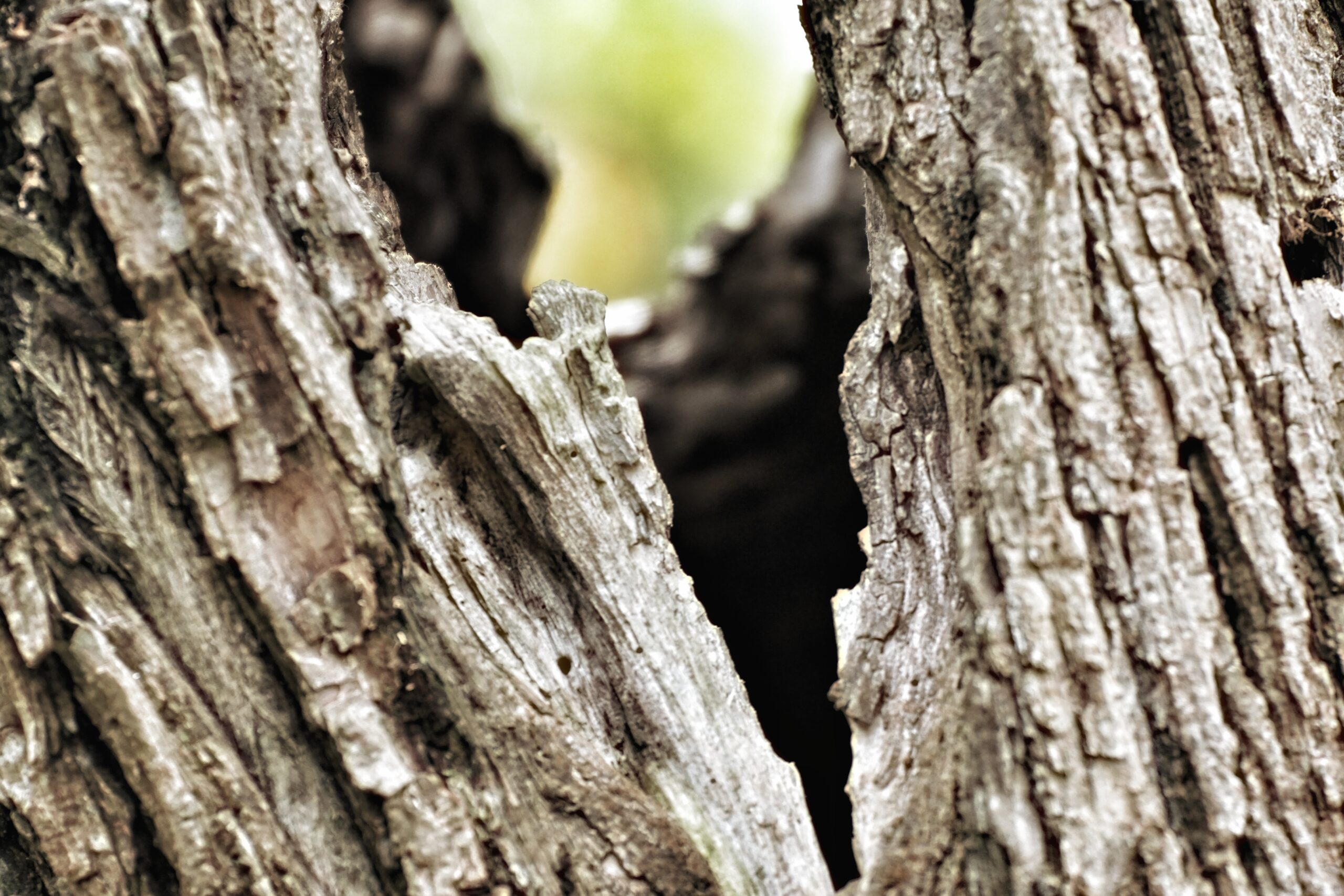
A tree splitting down the middle is almost always a serious structural problem, not a cosmetic one. A vertical crack usually means the tree has been under real stress, from a storm, a growth defect, lightning, or frost, and its ability to hold itself up is compromised. Any split wider than a hairline, or any split on a tree near a house or walkway, should be assessed by a professional promptly.
If your tree is actively splitting near a house, driveway, or power line, do not wait. Call 484-849-0153 for an immediate assessment.
Is Your Tree About to Fall? The 60-Second Check
Before you decide whether to call, run through this quick check.
- How wide is the crack? Hairline (under a quarter inch) is less urgent than finger-width or wider. The wider it is, the worse.
- Is it fresh or old? Bright, pale wood exposed inside the crack means the tree is actively splitting right now. Weathered gray wood means the crack is older and may be stable.
- Which way does the tree lean? A tree leaning in the same direction as the split is a major failure risk.
- Where is the split? A crack at or near ground level is the most dangerous. Splits higher in the trunk or crown are serious but often less immediately threatening.
- Any other signs? Look for sap oozing near the crack, bark peeling alongside it, mushrooms at the base, an uneven canopy, or creaking and cracking sounds when the wind blows.
If two or more of these apply, treat it as an emergency and get an assessment before the next storm rolls in.
5 Causes of Tree Trunk Splitting
Knowing the cause helps you understand the risk and prevent it next time.
- Storm damage and wind stress. High winds twist and load the trunk, and splits often start in the crotch of a co-dominant fork and run downward. Fresh splits with bright inner wood are the telltale sign. These carry a high risk of further failure and need urgent attention.
- Frost cracks. Winter temperature swings make the outer bark and inner wood contract at different rates, opening vertical cracks, usually on the sunny south or southwest side of the trunk. Frost cracks often reopen each winter but tend to stabilize over time on otherwise healthy trees.
- Lightning strikes. These are sudden and dramatic, leaving long vertical splits, burnt patches, and bark blown off entire sections. A tree that survives the strike can still fail structurally later, so it needs inspection even if it looks alive.
- Co-dominant leader failure. When two main stems grow from the same point in a tight V-shaped union, bark often gets trapped between them (called included bark), which weakens the attachment badly. This is the most common source of vertical splits in mature landscape trees, and it is a chronic defect rather than a one-time event.
- Internal decay. When a tree rots from the inside, the weakened wood eventually can no longer carry the tree’s weight, and it splits. This is often paired with mushrooms or conks at the base and dead branches in the canopy, and it sharply raises the risk of failure in high wind.
One more thing worth knowing: a vertical crack that runs along the grain is more manageable than a horizontal fracture, which cuts across the load-bearing fibers and almost always leads to failure. Species matters, too. Silver maple, Bradford pear, and willow are notoriously prone to splitting, while oaks and stronger hardwoods hold up better under stress. University of Florida Extension on split trunks offers a good technical overview of why trunks split and how bark inclusions set them up to fail.
When a Vertical Crack in a Tree Trunk Is an Emergency
Some situations cannot wait for a scheduled appointment. Call for an emergency assessment if any of these apply:
- The split extends more than a third of the way down the trunk.
- The tree is within falling distance of a house, power line, driveway, or play area.
- The crack is measurably opening wider from one day to the next.
- The tree is leaning in the direction of the split.
- Severe weather is in the forecast within the next 48 hours.
- You can hear cracking or popping from the tree in normal wind.
If any of these are true, do not park under the tree, do not let children play near it, and do not wait it out. A split tree near a target is exactly the kind of situation our emergency tree services are for.
Can a Split Tree Be Saved? Repair vs. Removal Decision
Sometimes a split tree can be stabilized, and sometimes removal is the honest answer. The right call depends on how much of the trunk is compromised, whether decay is present, and what stands below the tree.
When a Split Tree Can Often Be Saved
- Small vertical cracks affecting less than about a quarter of the trunk are frequently repairable.
- Split limbs that have not fully separated from the trunk.
- Healthy trees where the wood around the split is still sound.
- Trees that are not immediately threatening a structure allow time for a measured repair.
The main tools an arborist uses are cabling and bracing (steel cables high in the canopy or threaded rods through the union to hold split sections together), and structural pruning to reduce the weight loading the weak point. These work best on co-dominant leader failures caught early. It is important to understand that cabling and bracing are supports, not cures. The tree keeps its original defect, and the hardware requires periodic inspection to stay effective. Proper installation follows the ANSI A300 Part 3 standard, the national standard for tree support systems that qualified arborists follow.
When Removal Is the Honest Answer
- The split runs down more than roughly half the trunk, or wraps a large portion of its circumference.
- Internal decay is present. What matters is how much sound wood remains in the outer shell, and confirming that often takes instrument testing rather than a visual guess.
- The tree stands near a structure, and the split is actively progressing.
- The species is prone to catastrophic failure, like a mature Bradford pear or a silver maple with an established split.
When a split tree is beyond saving and threatens a house or line, our tree removal services can take it down safely, and for trees tightly boxed in against a structure, crane-assisted tree removal lets us lift the sections out under full control. For a split that is stable but concerning, a hazardous tree assessment is the right way to settle the repair-versus-remove question before it becomes urgent. As a rule, repair buys time on a defect rather than erasing it, and an honest arborist will tell you when a tree is past the point where cabling makes sense.
Common Tree Splits in Berks County and Pennsylvania
A few species account for most of the splits we see on local properties.
- Bradford pear is notoriously weak-wooded and splits catastrophically, often taking down limbs onto cars and lines. It is common on older suburban streets around Reading, Pottstown, and Boyertown.
- Silver maple grows fast and is brittle, and is common in older Pennsylvania neighborhoods.
- Willow, both weeping and black, has brittle wood, and split limbs are common after wind or ice.
- Wild cherry, native to Pennsylvania, is prone to splitting under storm stress as it ages.
Winter storms, summer thunderstorms, and southeastern Pennsylvania’s freeze-thaw cycles all drive splitting and frost cracking here. Penn State Extension on storm damage is a solid local resource for recognizing and preventing storm-related tree failures.
Frequently Asked Questions
Will a split tree fall soon?
It depends on the split’s size, direction, and the tree’s other conditions. A fresh, wide vertical crack in a tree trunk that is actively opening on a leaning tree can fail within days. A small, old, weathered split on an otherwise healthy tree can hold for years. Because a photo cannot show what is happening inside the trunk, the honest answer is to get it assessed rather than guess.
Can you glue or fill a crack in a tree trunk?
No. Wound sealants, expanding foam, and glues do not fix a structural split. They trap moisture, promote decay, and make the tree harder to inspect properly. Cabling and bracing installed by a certified arborist is the actual professional solution.
Should I bolt a split tree trunk myself?
This is not a DIY job. Improper bolting can make a tree more dangerous by concentrating stress in the wrong places. The hardware has to be correctly sized, placed at the right angle, and paired with weight-reduction pruning, which is work for a trained arborist.
How much does it cost to cable a split tree?
Cabling and bracing typically run a few hundred dollars for a straightforward single-cable job, more for multi-cable or bracing-rod systems on larger trees, plus a modest annual inspection. When cabling is a viable option, it is often more affordable than removing and replacing a mature tree. The only way to get an accurate number is an on-site look, since the tree’s size, the number of cables, and access all factor in.
Is a tree with a vertical crack still alive?
Usually yes, at least at first. A vertical split in a tree trunk affects its structure, not necessarily its vascular system, so the tree can be alive and fully leafed out while still being a serious failure risk. The concern with a split is not the tree dying. It is the tree falling.
If you are looking at a tree splitting down the middle and are not sure how serious it is, the safest move is to have it looked at before the next storm makes the decision for you. Contact Merkel’s Tree Service for an assessment anywhere in Berks County.