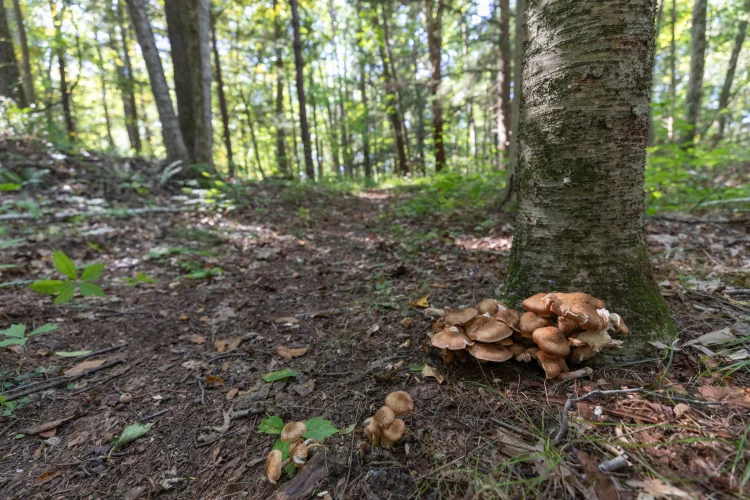
Mushrooms at the base of a tree usually signal fungal activity in the root system, and that often, though not always, means the tree is decaying from the inside. Some mushrooms are harmless and feed on dead surface material, such as mulch or old wood.
Others, including honey fungus (Armillaria) and artist’s conk (Ganoderma), point to serious internal decay. Correct fungus on tree trunk identification is the first step, so before you do anything, figure out what you are actually looking at. Merkel’s Tree Service, serving Berks County, can help with that.
What Mushrooms at the Base of a Tree Actually Indicate
A mushroom is the visible fruiting body of a fungus that lives mostly out of sight, either underground or inside the wood of the tree. When mushrooms appear at the base of a tree, the fungal network below is feeding on something. The question that matters is what.
There are three common situations, and they are not equally serious.
- Mushrooms in mulch or lawn around the tree. These usually feed on dead organic matter: mulch, old roots, buried wood chips, or other debris. They are often not harming the tree at all and may just reflect normal decomposition. They can look unpleasant, but when they are not attached to the roots or trunk wood, they are typically harmless to the tree’s structure.
- Mushrooms on the trunk, exposed roots, or at the root flare. This is the situation that matters most. When mushrooms or shelf-like conks emerge directly from the bark, from visible roots, or right at the soil line, it usually means wood decay inside the tree or active root rot. The fungus is consuming structural tissue and reducing the tree’s strength over time.
- Mushrooms on old stumps or at stump-grinding sites. After a tree comes out, fungi routinely colonize the leftover stump and buried root fragments. Here, mushrooms usually signal normal decomposition of dead wood rather than a threat to living trees nearby.
One hard truth about scenario two: visible mushrooms often appear years after the internal decay began. By the time the fungus fruits, it has usually been at work inside the tree for a long time.
6 Common Mushrooms Growing on Trees (and What Each One Means)
Visual identification is where most homeowners get stuck. Here are six you are most likely to encounter, with what each one tells you. Accurate tree fungus identification still calls for a trained eye, so treat this as a starting point rather than a final diagnosis.
- Armillaria mellea (Honey Fungus)
- Appearance: Clustered honey-colored to yellow-brown mushrooms at the base or over the roots, often with a ring on the stem and flat caps. A strong mushroom odor is common.
- What it indicates: Decomposition of organic material in the landscape bed. If you are seeing white mushrooms on the tree base area but in the surrounding mulch rather than on the wood itself, this is usually the harmless type.
- Severity: Serious, and often lethal to the tree.
- Ganoderma applanatum (Artist’s Conk)
- Appearance: Hard, woody, shelf-shaped conks, brown on top with a white underside that bruises dark when scratched.
- What it indicates: Butt rot and extensive internal decay at the base of the tree.
- Severity: Serious. Usually signals significant structural decay.
- Inonotus dryadeus (Weeping Conk)
- Appearance: Large tan to grey-brown conk at the base or root flare that oozes amber droplets when fresh.
- What it indicates: Root and butt rot, most often on oaks.
- Severity: Serious, particularly for mature oaks, and a recognized failure risk.
- Pleurotus ostreatus (Oyster Mushroom)
- Appearance: Fan-shaped, off-white to grey clusters growing on wood.
- What it indicates: Decay of already-dead or stressed wood tissue.
- Severity: Moderate. An indicator of decay on wood that is already compromised.
- Grifola frondosa (Hen of the Woods / Maitake)
- Appearance: Large, layered, gray-brown clustered mass at the base, typically of oaks.
- What it indicates: Butt rot at the base of the tree.
- Severity: Can indicate advanced internal decay.
- White or beige soft mushrooms on mulch
- Appearance: Small, soft mushrooms appearing in mulch beds or compost, not attached to the tree.
- What it indicates: Decomposition of organic material in the landscape bed.
- Severity: Usually harmless to the tree.
Photos of each species should accompany this section to help readers match what they are seeing.
When Mushrooms Growing on a Tree Means Your Tree Is Dying
Mushrooms tell you that decay or decomposition is happening, but they do not tell you how far along it is. To read the real risk, look at the mushrooms alongside other signs. The following combinations should prompt a professional assessment right away:
- Large mushrooms or conks attached directly to the bark or visible roots.
- Multiple species or large clusters appearing in a single season.
- Mushrooms plus other decline symptoms like canopy thinning, dead branches, or bark loss.
- Mushrooms plus a noticeable lean, especially toward a house, driveway, or play area.
- Mushrooms plus recent cracking sounds, falling limbs, or visible trunk splitting.
- Mushrooms appearing after a recent storm or other stress event.
Here is why this matters so much: mushrooms tend to appear late in the decay process. The fungus has often been breaking down the inside of the tree for years before it fruits, so by the time you see mushrooms on the trunk, the tree may already be structurally compromised, even while the canopy still looks fine from the ground. That gap between how a tree looks and how sound it actually is, is exactly what makes these signs worth taking seriously.
Common Tree Fungi in Berks County and Southeastern Pennsylvania
Berks County’s humid summers and mild, wet winters create conditions that favor fungal growth more than drier regions do. A few threats show up repeatedly on local trees.
- Armillaria root rot is widespread across Pennsylvania hardwoods and landscapes, and it is a frequent finding on local oaks, maples, and many other species.
- Ganoderma shows up regularly on mature shade trees in older neighborhoods around Reading, Pottstown, and Boyertown, where large, aging trees are common.
- Weeping conk (Inonotus dryadeus) appears at the base of mature oaks and is a recognized decay indicator in the region.
- Oak wilt is worth knowing about as a separate concern. It is caused by a fungus, but unlike the others here, it is a vascular disease, not a base-of-tree mushroom. Its first signs are wilting and browning leaves in the canopy, not conks at the root flare. It spreads between red oaks through connected roots and is a serious regional threat, just one that presents differently from what this article covers.
Trees most at risk locally include red oak, white oak, sugar maple, and ash. A local team that works on these species regularly, like our residential tree services in Berks County, will recognize these patterns quickly.
What to Do If You Find Mushrooms Growing at the Base of Your Tree
If you spot mushrooms at the base of a tree, work through these steps in order.
- Do not panic, and identify first. Take photos, both a close-up of the mushrooms and a wider shot showing the whole tree.
- Note the exact location. Distinguish between mushrooms on the trunk or root flare, on exposed roots, and out in the surrounding soil or mulch. This is the single most important detail.
- Check the tree for other symptoms. Look at canopy density, dead branches, bark condition, and any lean.
- Do not remove the mushrooms. Pulling them off does nothing to help the tree, since the fungus lives inside the wood or soil, and it destroys the evidence an arborist needs to identify the problem.
- Get a professional assessment if the mushrooms are on the trunk, on exposed roots, or paired with any other decline symptoms.
- Understand the likely outcomes. Minor surface fungi usually just need monitoring. Root or trunk decay needs an assessment. Advanced decay often means removal.
If you have spotted mushrooms growing at the base of a tree in Berks County, Merkel’s can perform a hazardous tree assessment, which is the right next step when the signs point to decay.
Can a Tree Recover from a Fungal Infection?
For most serious cases, the honest answer is no. Deep wood-decay fungi and root rots cannot be cured once they are established.
- Root and heart rot are irreversible. Decayed structural tissue does not regenerate or return to full strength.
- Fungicides and soil treatments have limited effect on an infection that is already established, and they are not a reliable fix for something like Armillaria or Ganoderma.
- The realistic path is risk management, which means determining how far the decay has progressed and how likely the tree is to fail, then deciding between monitoring and removal.
- Removal is often the right call when decay is advanced, and the tree is near a structure, walkway, or anywhere people gather.
Healthy neighboring trees can sometimes be protected by reducing their stress and, where appropriate, addressing soil conditions. When removal is the outcome, our tree removal services handle compromised trees safely, which matters because internal decay makes a tree unpredictable to take down. This is the straight reality of the situation, and a clear-eyed assessment beats false hope every time.
Frequently Asked Questions
Are mushrooms growing at the base of my tree dangerous to my family or pets?
Some tree fungi are toxic if eaten, and children and dogs are the most at risk. Touching them is generally not a concern, but eating them can be. Until you know what you are dealing with, keep kids and pets away from them.
Should I remove the mushrooms from around my tree?
No. Removing the visible mushrooms will not help the tree, because the actual fungus lives inside the wood or in the soil. The mushroom is only the reproductive structure. Removing it also destroys the evidence an arborist needs to identify the species, so photograph them and leave them in place.
Will tree fungus spread to my other trees?
It can. Some fungi, especially Armillaria root rot, spread through root-to-root contact between trees, which means a healthy neighbor can become infected. This is one reason identification matters, since containment and spacing decisions depend on knowing what is present.
How long does it take for a tree with root rot to die?
It varies widely. Some trees decline within one to two years, while others hold on for five to ten years with visible mushrooms. The bigger danger is not how fast the tree dies but structural failure, since a decaying tree can fall before it is actually dead, particularly in a storm.
Can I just cut down the tree myself if it’s infected?
Only if it is small and well away from any structures. Infected trees often have unpredictable internal decay, which makes them genuinely dangerous to fell, since they do not always behave the way a sound tree would. For anything large or close to a building, a professional assessment and removal is the safer choice.